

.avif)
.png)
The short answer
If you want to buy a home in North Carolina and you're short on cash, you don't need a second career. You need three things: a real number to hit, a deadline, and two or three income streams stacked on top of each other. Most Triangle buyers who get serious can put together $10,000 to $20,000 in 12 to 18 months by cutting one category of spending, picking up one recurring weekend gig, and selling one skill they already have. The 20 ideas below are sorted by how fast they pay.
First, stop aiming at the wrong number
Here's the thing that keeps people renting for an extra three years: they think they need 20% down.
You almost certainly don't.
The median home price across the Triangle has been sitting right around $425,000. Here's what the down payment actually looks like at that price point, depending on the loan:
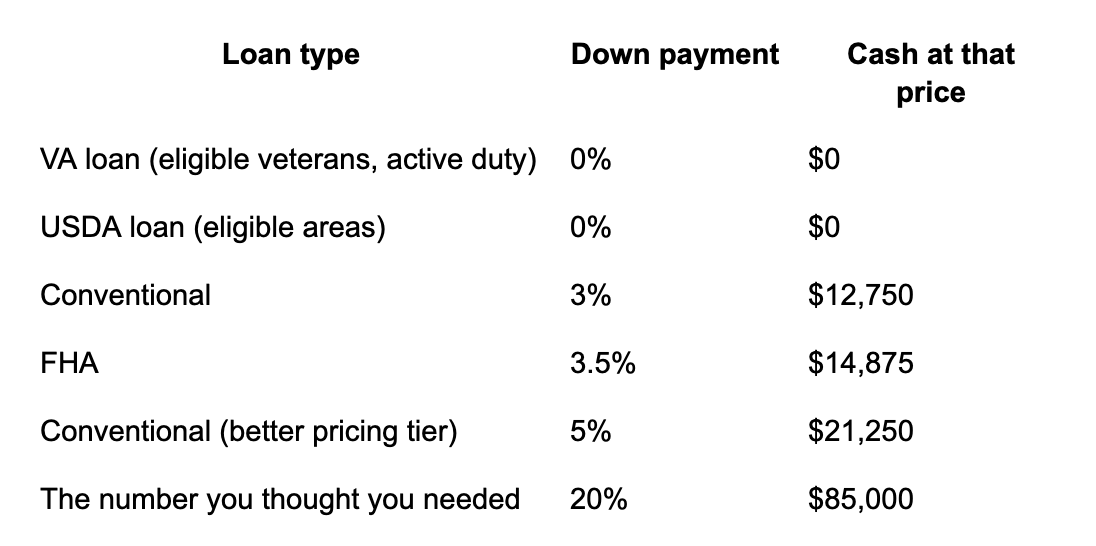
Then budget roughly 2% to 5% of the purchase price for closing costs and prepaid items, and understand that a good portion of that can often be negotiated onto the seller in this market. The Triangle has sitting inventory right now. Homes are taking a month or more to move. Sellers are paying closing costs again.
So before you go pick up a second job, understand what you're actually saving toward. For a lot of buyers, the honest target is $12,000 to $18,000, not $85,000. That's a completely different mountain.
And that number can drop further. We offer two down payment assistance structures that most buyers have never heard of:
- Boosted DPA: up to 101.5% financing, covers down payment plus closing costs, small monthly payment on the assistance portion. Built for buyers who want to keep cash in the bank.
- Forgivable DPA: 100% financing, no monthly payment on the assistance, fully forgiven after 10 years. You only pay it back if you sell or refinance early.
Eligibility depends on credit, income, and the property. That's exactly the kind of thing worth a 15 minute conversation before you spend 18 months saving toward a number you may not need.
Build your number before you build your hustle
Do this on your phone right now. It takes four minutes.
Step 1. Pick your target price range. Step 2. Pick your realistic down payment percentage (3%, 3.5%, or 5% for most first-time buyers). Step 3. Add 2% for closing costs you may have to cover. Step 4. Subtract what you already have saved. Step 5. Divide by the number of months until you want keys in hand.
That last number is your monthly gap. It's the only number that matters from here forward.
Example: a $400,000 home, 3.5% FHA down ($14,000), plus $8,000 in closing costs, minus $4,000 already saved, equals $18,000 needed. Over 18 months, that's a $1,000 monthly gap.
Now here's the mindset shift. You are not going to find one thing that generates $1,000 a month. You're going to find three things that generate $300 to $400 each, and they're going to stack.
Tier 1: Money you already have (start today, no new hours)
This is where almost everyone leaves the most money on the table, and it's the fastest cash in the entire list. Do this tier first.
1. Run a 90-day statement audit
Pull the last three months of checking and credit card statements. Highlight every recurring charge. Not the ones you think are there. The ones that are actually there.
Most people find $80 to $250 a month in things they forgot about entirely. Streaming services stacked four deep. A gym you stopped going to in March. App subscriptions that renewed annually. A "free trial" from 2024. Insurance riders. That storage unit.
Cancel with intent. Then immediately move that exact dollar amount into a separate savings account, because money you don't move is money you spend.
Realistic monthly impact: $80 to $250.
2. Re-shop your car and renters insurance
Insurance companies price loyalty at a premium, not a discount. If you haven't shopped your auto policy in two years, you're likely overpaying. Get three quotes with identical coverage limits so you're comparing apples to apples. Bundle if it helps. Raise your deductible only if you have an emergency fund that can absorb it.
One important note: do this now, not while you're under contract. Big changes to your financial picture during underwriting create questions.
Realistic monthly impact: $40 to $150.
3. Sell what's already in your house
Walk your garage, closets, and spare room with the mindset of someone moving in six months. Because you are.
The stuff that actually moves in the Triangle: furniture, baby and kid gear, tools, exercise equipment, gaming consoles, bikes, kayaks, designer bags, and anything related to a hobby you've stopped doing. Facebook Marketplace moves furniture and large items fastest. eBay and Poshmark handle clothing and collectibles better. Local buy-sell-trade groups will move kid gear in a weekend.
Set a rule: everything under $50 goes on Marketplace with a "must pick up this weekend" note. Everything over $200 gets photographed properly.
Realistic one-time impact: $400 to $3,000.
4. Automate a split direct deposit
Ask your payroll department to split your direct deposit so a set amount goes into a separate savings account at a different bank than your daily checking. Different bank matters. Friction is the point.
Label the account something that means something to you. "Kitchen table." "Fenced yard." "1420 Something Street." Do not link it to your debit card.
This doesn't create money. It protects the money the other 19 ideas generate, which is why it belongs in the top five.
5. Check your tax withholding
If you got a large refund last year, you loaned the government money at 0% interest for twelve months. Adjusting your W-4 turns some of that refund into monthly cash flow you can actually save and earn interest on.
Talk to a tax preparer before you change anything, especially if you're picking up 1099 side income (see the underwriting section below, because this matters more than you think). Under-withholding creates a tax bill, and a tax bill creates a problem in underwriting.
Realistic monthly impact: $100 to $400.
Tier 2: Trade hours for dollars (start this weekend)
These require time, not talent. They start paying within days.
6. Overtime and extra shifts at your current job
This is the single most overlooked option on the list, and it's usually the best one.
You already know the work. There's no ramp-up. You're paid at time-and-a-half in many cases, which is a higher effective hourly rate than almost any gig app will ever produce. And here's the part that matters for your loan: it shows up on a paystub and a W-2. It's the cleanest possible money in the eyes of an underwriter.
Before you download three delivery apps, go ask your manager what's available.
Realistic monthly impact: $300 to $1,200.
7. Delivery driving
DoorDash, Uber Eats, Instacart, Shipt. Flexible, immediate, and you control the hours completely.
Where and when matter enormously. In the Triangle, the money is concentrated around dinner rush in downtown Raleigh, North Hills, Cary, and the campus corridors near NC State, Duke, and UNC. Weekend lunch near shopping centers. Bad weather is your best friend, because demand spikes and drivers stay home.
Track your mileage from day one. It's a real tax deduction and you'll want the records.
Realistic monthly impact: $400 to $1,000 at 10 to 15 hours a week.
8. Rideshare during high-demand windows
Uber and Lyft, but strategically. Airport runs to and from RDU on Sunday evenings and Monday mornings. Concert and event nights around Lenovo Center, Red Hat Amphitheater, and Coastal Credit Union Music Park. Late-night downtown Raleigh and Durham on Friday and Saturday.
Driving 40 random hours produces average money. Driving 12 targeted hours produces most of the same result.
Realistic monthly impact: $400 to $900.
9. Event, stadium, and festival work
The Triangle runs on events, and events run on temporary staff. The NC State Fair alone employs a small army every October. Add Hurricanes games, college athletics, Dreamville, Koka Booth concerts, downtown food festivals, and convention center trade shows.
Look at staffing agencies, the venues directly, and the concessions contractors. Pay is modest hourly but the shifts are consistent, seasonal, and stack well on top of a Monday-through-Friday job.
Realistic monthly impact: $300 to $700 in season.
10. Weekend catering, bartending, and serving
Restaurants and catering companies across the Triangle are chronically short on weekend coverage. Two Saturday night shifts a month is a car payment. Four is a real dent in your gap.
If you're going to do this, get your ABC permit and consider a bartending certification. Bartenders out-earn servers meaningfully, and private event bartending pays better than restaurant work with less chaos.
One warning: tips in cash are the hardest money in the world to document for a mortgage. Deposit everything. See Tier 5.
Realistic monthly impact: $400 to $1,200.
11. Pet sitting and dog walking
Rover and Wag, or better yet, build your own client list through neighborhood Facebook groups and word of mouth so you keep the full fee.
Overnight boarding in your own home is the highest-value version of this, especially around Thanksgiving, Christmas, and spring break when demand outstrips supply badly. If you're a renter, check your lease first.
Realistic monthly impact: $200 to $800.
12. Youth sports officiating and umpiring
Wildly underrated. Wake, Johnston, Durham, and Orange County recreation departments are perpetually short on officials for soccer, basketball, baseball, softball, and volleyball. Certification is inexpensive and fast. Games are on Saturdays, run 60 to 90 minutes, and you can often work three or four in a morning.
If you played the sport, you're already most of the way qualified.
Realistic monthly impact: $250 to $700 in season.
Tier 3: Sell a skill (the highest ceiling per hour)
Tier 2 caps out because you only have so many hours. Tier 3 doesn't, because you're being paid for what you know rather than how long you stood there.
13. Tutoring and test prep
The Triangle is one of the most education-dense markets in the Southeast. Parents here will pay real money for SAT, ACT, AP, and math tutoring. So will college students for chemistry, calculus, and statistics.
You do not need a teaching degree. You need to be genuinely good at one subject and reliable. Start with school counselors, neighborhood groups, and existing parent networks. Online platforms work, but they take a cut and cap your rate.
Realistic monthly impact: $400 to $1,500.
14. Freelance the skill you use at your day job
Whatever you're paid to do 40 hours a week, someone smaller will pay you to do 5 hours a week.
Bookkeeping. Payroll setup. Spreadsheet building. Graphic design. Social media management. Video editing. Copywriting. Website maintenance. Photography. Small business owners across Wake and Johnston County need all of it and can't justify a full-time hire.
Check your employment agreement for non-compete or moonlighting clauses first. Then tell fifteen people what you're offering. That's usually all it takes.
Realistic monthly impact: $500 to $2,500.
15. Become a Notary Signing Agent
This one is specific and worth serious consideration.
North Carolina notary commissioning is straightforward and inexpensive. Add signing agent certification and background screening, and you can be paid per closing to walk borrowers through loan document signings. The work is evenings and weekends, the appointments run about an hour, and the per-signing fee is meaningful.
Bonus: you'll learn the mortgage process from the inside, which will make you a sharper buyer when it's your turn.
Realistic monthly impact: $300 to $1,200.
16. Weekend trade work
Pressure washing. Gutter cleaning. Mulch delivery and spreading. Lawn care. Fence repair. Deck staining. Furniture assembly. Small handyman jobs. TV mounting. Holiday light installation in November and December.
Neighborhood Facebook groups in Cary, Apex, Holly Springs, Wake Forest, and Clayton are full of homeowners looking for exactly this and struggling to get calls returned. Show up when you said you would and you'll have more work than you can handle.
Startup cost is low. A pressure washer pays for itself in about three jobs.
Realistic monthly impact: $400 to $1,800.
17. Teach fitness, coach, or run a class
Group fitness instruction, personal training, private sports lessons, music lessons, or a weekend workshop teaching something you're good at. Certification requirements vary. Gyms and studios across the Triangle are consistently looking for early morning and evening instructors.
Realistic monthly impact: $300 to $900.
Tier 4: Rent what you already own
The highest dollar-per-effort category on this entire list, because the asset does the work.
18. Rent a room or take on a roommate for 12 months
This is the single most powerful move available to most renters, and almost nobody wants to hear it.
A roommate paying $700 to $900 a month for twelve months is $8,400 to $10,800. That's an entire FHA down payment on a $400,000 home. Twelve months of mild inconvenience in exchange for the keys.
Check your lease. Screen carefully. Put it in writing. Set an end date and hold to it.
Realistic monthly impact: $600 to $1,000.
19. Rent your driveway, parking space, or storage space
If you live near downtown Raleigh, NC State, Duke, UNC, or any event venue, your parking space has value on game days and event nights. Apps like SpotHero and Neighbor facilitate this. Neighbor also lets you rent out garage space, basement space, or a spare room for storage.
Nearly pure profit. You already pay for the space.
Realistic monthly impact: $100 to $400.
20. Rent your truck, trailer, or equipment
Own a pickup, a utility trailer, a boat, a camper, camera gear, or specialty tools? Platforms exist for all of it. Turo for vehicles. Outdoorsy and RVshare for campers. ShareGrid for camera gear. Local Facebook groups for trailers and tools.
Verify insurance coverage before you list anything. Your personal auto policy likely doesn't cover commercial rental use.
Realistic monthly impact: $150 to $600.
All earnings ranges above are illustrative estimates based on typical Triangle-area rates and are not guarantees of income.
The part nobody tells you: how underwriting actually sees your side hustle money
Here's where this blog gets different from every other "20 side hustles" article you'll find.
I've been doing this since 1999. I've watched buyers grind for eighteen months, build up a beautiful down payment, and then nearly lose the house because of how the money landed in their account. Not because of the amount. Because of the paper trail.
Read this part twice.
Every large deposit gets questioned
Underwriters review 60 days of bank statements. Any deposit that doesn't obviously match your payroll gets flagged, and you'll be asked to document where it came from. That's called sourcing. If you can't source it, it doesn't count toward your down payment. Full stop.
So keep the receipts. Screenshots of your DoorDash weekly payout. Venmo history from tutoring clients. Marketplace sale confirmations. A signed roommate agreement with matching monthly transfers. It takes ten seconds to save a screenshot and it can save your closing.
Cash is the hardest money to use
Cash tips, cash from selling a couch, cash from a lawn job. If it never touches a bank account, it effectively doesn't exist to a lender.
Deposit it. Consistently, in modest amounts, into the account you'll use for closing. Don't stuff an envelope for a year and then walk $6,000 into the bank three weeks before closing. That deposit will be questioned and it will be very hard to explain.
One account, please
Run every dollar of side income into a single dedicated savings account. Not four accounts, three Venmo balances, a Cash App, and a jar. Every additional account is another set of statements you'll have to produce and explain.
Simple beats clever here every single time.
Side income for the down payment is different from side income for qualifying
This is the distinction that trips people up.
To use side hustle income to qualify for a larger loan, a lender generally needs a two-year history of it. Most new side income won't help your qualifying number right away.
But to use it as down payment funds, it just needs to be sourced and seasoned in your account. That's it.
So don't let anyone tell you the hustle is pointless because it's new. It's not. It's just doing a different job than you think.
The Schedule C trap
Here's the one that actually costs people houses.
If you file self-employment income on a Schedule C and that business shows a net loss, that loss gets subtracted from your qualifying income. You worked all year to save for a house, and the tax return you filed to be smart about deductions just lowered the loan amount you qualify for.
I'm not telling you to skip legitimate deductions. I'm telling you to talk to us and your tax preparer before you file, in the year you plan to buy. There's real strategy available here, and it has to happen before the return is filed, not after.
Don't open new credit to fund the hustle
New credit cards, a financed pressure washer, a personal loan for a car to drive rideshare. All of it hits your credit score and your debt-to-income ratio at the worst possible moment.
If you think you need to finance something to start earning, call us first. That five minute conversation has saved more deals than I can count.
If someone's helping you, structure the gift correctly
Family help is common and completely allowed on most loan programs. But it has to be documented as a gift, with a gift letter, a paper trail from the donor's account to yours, and in some cases proof of the donor's ability to give. A $10,000 "loan" from a parent that gets treated as a gift on paper is a compliance problem, not a shortcut.
Bring us in early and we'll structure it right the first time.
Your 90-day plan of attack
Stop reading. Start here.
Week 1
- Calculate your monthly gap using the five steps above.
- Open a separate savings account at a bank you don't normally use.
- Book a strategy call with us so you know your actual target instead of guessing at it.
Weeks 2 to 4
- Complete your 90-day statement audit. Cancel everything dead.
- Get three insurance quotes.
- Set up your split direct deposit.
- Photograph and list ten items from your house.
Weeks 5 to 8
- Pick exactly one Tier 2 gig. One. Not four apps.
- Ask your manager about overtime availability.
- Start a folder on your phone for income documentation. Screenshot every payout.
Weeks 9 to 12
- Add one Tier 3 skill-based stream at a higher hourly rate.
- Have the roommate conversation if it applies to your situation.
- Check your progress against the gap and adjust.
Month 4 and beyond
- Keep going. Review your credit report. Don't open new accounts.
- Check back in with us at the halfway point so we can course-correct before it matters.
Three streams. One dedicated account. Documentation from day one. That's the whole plan.
Frequently asked questions
How much money do I actually need for a down payment in North Carolina? Between $0 and about 5% of the purchase price for most buyers. VA and USDA loans allow 0% down for eligible borrowers. Conventional loans start at 3% and FHA at 3.5%. On a $425,000 Triangle home, that's roughly $12,750 to $14,875, plus closing costs of about 2% to 5% that can often be negotiated onto the seller.
Can I use side hustle money for a down payment? Yes. Down payment funds need to be sourced and seasoned in your bank account, meaning you can document where they came from. This is different from using side income to qualify for the loan itself, which generally requires a two-year history.
How long does money need to be in my account before I buy? Lenders typically review 60 days of bank statements. Money that has been in your account across that full window is considered seasoned. Newer deposits aren't disqualified, they just need documentation showing where they came from.
What's the fastest way to save for a down payment? Cut recurring expenses first, because that money is available immediately and requires no new hours. Then stack one time-based gig and one skill-based gig. Most people can generate $800 to $1,200 a month within 60 days using that combination.
Will taking a second job hurt my mortgage approval? No, and it usually helps by building your reserves. Just avoid opening new credit to fund it, keep all income in one documented account, and talk to your tax preparer before filing if the income is self-employment income, since business losses can reduce your qualifying income.
Do I need 20% down to avoid PMI? Twenty percent avoids mortgage insurance on a conventional loan, but that's not the only path. Lender-paid options, VA loans, and certain program structures handle it differently. For most buyers the math on waiting years to reach 20% is worse than buying sooner with mortgage insurance you can later remove.
Are there down payment assistance programs available in North Carolina? We offer two structures for eligible buyers. One provides up to 101.5% financing covering down payment and closing costs with a small monthly payment on the assistance. The other provides 100% financing with no monthly payment on the assistance, fully forgiven after 10 years, repayable only if you sell or refinance early. Eligibility depends on credit, income, and property.
Should I get pre-approved before or after I save the money? Before. A strategy conversation early tells you your real target number, which is frequently lower than what you assumed. Buyers who guess at the number often save toward a figure they never needed and delay their purchase by a year or more.
Can my parents give me the down payment? Yes, on most loan programs. It has to be documented as a gift with a gift letter and a clear paper trail from their account to yours. Some programs require proof of the donor's ability to give. Structure it correctly on the front end and it's completely routine.
What if my credit isn't ready yet? Save and repair at the same time. Both take months, and running them in parallel instead of sequentially can cut a year off your timeline. We'll pull a report and give you a specific plan for what to pay, what to leave alone, and in what order.
The move that saves you the most time isn't on this list
Twenty ways to make money is useful. But the biggest timeline compressor for most buyers isn't earning more. It's finding out the target was smaller than they thought.
Every week I talk with someone who's been saving toward $60,000 when their actual number was $16,000. They lost two years to a bad assumption.
That's why every client here gets a strategy call before they apply, not after. We look at your income, your credit, your timeline, and what you actually have, and we tell you the real number and the fastest legitimate way to get there. Sometimes that means a program you didn't know existed. Sometimes it means fixing one thing on your credit report. Sometimes it means you're closer than you thought and we should be looking at houses this fall.
No application. No credit pull to have the conversation. Just a straight answer about where you stand.
Ready to find out your real number? Schedule a strategy call at thesherryrianoteam.com/get-in-touch or call (919) 234-7415.
Save this article. Start with Tier 1 tonight. And keep our number handy for the day the account balance says you're ready, because that day comes faster than most people expect.
The Sherry Riano Team | 215 E. Chatham St., Suite 301, Cary, NC 27511 | (919) 234-7415
Sherry Riano, Mortgage Loan Originator, NMLS #71774, is licensed in NC and may only solicit and accept loan applications and originate loans on properties in NC. Developer's Mortgage Company (NMLS #225548) is licensed by the North Carolina Commissioner of Banks, Mortgage Lender License #L-183246. Equal Housing Lender. This is not a commitment to make a loan. Eligibility is subject to credit approval. Loan availability and rates are based on market conditions and may change without notice. Underwriting terms and conditions apply. Income figures referenced are illustrative estimates and not guarantees of earnings. This article is educational and is not tax or legal advice. Consult a qualified tax professional regarding your individual situation.
.png)
.png)
.png)
